Last August, eighty years have passed since the signing of the Decree of the President of the Republic No. 50/1945 Coll., On measures in the Film Industry, which effectively nationalised the Czechoslovak film industry. It was the first nationalised industry in post-war Czechoslovakia. It is, however, impossible to understand all the reasons and describe the path that led to this step without outlining broader context and events that took place in the film industry, not only during the Second World War, but also in the preceding decades. The decree itself wasn’t born in a vacuum, it was the product of long-term efforts and processes, but also to a large extent a reflection of the post-war revolutionary reality. The ambition of this text is to describe and interpret the genesis of this document from the perspective of a long-term development of the domestic film industry.
The relationship between the state and the film industry in our country underwent a dynamic development from the beginnings of film to the end of the Second World War, which resulted in the establishment of a state film monopoly in 1945. But the idea of a state film industry isn’t one born in the 1940s. These propositions appeared not only in our country but in many European countries already in connection with the end of the First World War and the increase in left-wing sentiments in the society. The intentions most often concerned cinemas. In this context, the plan of the Hungarian Prime Minister Sándor Wekerle is often mentioned. In June 1918, he submitted a proposal to expropriate all Hungarian cinematographic theatres. According to his proposals, the municipalities were to assume ownership of the cinemas and make use of their profits.[1] Although similar ideas appeared, particularly in left-wing circles, in the first post-war years in Czechoslovakia, there was no nationalisation of any segment of the film industry in the interwar period.
In terms of competencies, the Czechoslovak film industry was divided between two ministries during the time of the First Czechoslovak Republic. It was the Ministry of the Interior, in charge of film censorship and issuing cinematographic licenses for the operation of cinemas; and the Ministry of Industry, Trade and Commerce, tasked in overseeing the production and trade of films. As for film legislation, it is important to mention that after the First World War, no new film laws were adopted, so during the period of the First Czechoslovak Republic, the entire industry was governed primarily by laws and ministerial decrees from the Austro-Hungarian era. The outdated legislation became one of the topics that was discussed the most in film circles throughout the 1920s and 1930.
The greatest effort to bring about changes in the film industry during the First Czechoslovak Republic was made predominantly by professional unions which had started appearing in the early 20th century. By the 1930s, they had become established organisations defending the interests of individual branches of the film industry. The interests of film distributors and producers were defended by the Union of Film Production and the Union of Film Industry and Trade. The cinema owners were represented by the Central Union of Cinemas.[2] Throughout the 1920s and the 1930s, this union strived to make the operation of cinemas a licensed business. The common interest of these professional unions and the subject of their lobbying at authorities consisted primarily of the effort to push through new legal regulations of the industry which would secure a greater economic stability for it.
The 1930s saw the emergence of more film institutions whether they were established on the initiative of film unions, the state or private individuals aiming to support domestic film production and its quality. We can begin with naming the Film Advisory Board established by the Ministry of Industry, Trade and Commerce in connection to the introduction of a registration system for film import in 1934. It was composed of representatives of film unions and several ministries.[3] The importance of this institution was crucial for future development as it was in charge of granting licenses to foreign films and allocating financial support to individual domestic film projects. The operation of this institution demonstrates a certain shift in the state’s view on the film industry. It began to perceive it not only from an economic perspective but also from a cultural and artistic perspective.[4]
Another institution that played a significant role in the process of the nationalisation of the film industry was the Czechoslovak Film Company. It was established on the initiative of Vladislav Vančura in October 1936 and united various personalities with interest in domestic film. As its goal, this institution set an effort to ‘strive, through constructive cultural work, to increase the responsibility of domestic film production to the real interests of the state and nation thus making Czech film an active component not only of economic but also of cultural and political life.’[5] Another ambition of the Czechoslovak Film Company was to establish cooperation with public authorities which was achieved in 1937 when its representatives became members of the Film Advisory Board.
Last but not least, we need to mention the Film Studio, originally established as a section of the Union of Film Production but in 1937, it became an independent association whose members included all important film unions and other institutions such as the Czechoslovak Film Company and later also the Masaryk Institution of Popular Education. For its efforts to promote cooperation between individual parts of the film industry, this institution can be described as an important factor in the integration of individual fields.[6] As evidenced by the minutes of the founding general meeting of this association, the impulse for its establishment was the lack of authority of the Film Advisory Board which, according to the members of the Film Studio, intervened in Czechoslovak film production only in economic terms and not in cultural and artistic terms.[7]
The establishment of the International Film Chamber of which Czechoslovakia became a member helped to strengthen the ideas of integration in the industry. The representatives of the Czechoslovak film industry had an opportunity to compare their situation with other European countries where the film industry received a significantly greater state support. Many individual countries also had a central institution in the form of a local national film chamber. In connection to the establishment of the International Film Chamber, the magazine Filmový kurýr mentioned a list of countries that already had their film chamber followed by a lament: ‘We named many countries. Czechoslovakia is not one of them. An institution which would cover everything related to film would be most needed in our country.’[8]
The aforementioned professional unions played a central part in the centralisation of the Czechoslovak film industry. Their mutual cooperation strengthened during the 1930s. The idea of integration had pragmatic reasons. The Czechoslovak Film Chamber, or a similar subject, would improve the position of the domestic film industry on several levels. It would improve and simplify the position of the film industry in negotiations with the state. It was also assumed that the state would financially support such an organisation which, in addition to economic stability, would secure a better social situation for film workers. It would make the position of the Czechoslovak film industry more favourable in negotiations at an international level. Preparations for the establishment of such an institution intensified as a result of the tense political situation in 1937 and 1938. There was even a draft of a government regulation on the organisation of film economy, but it wasn’t adopted before the events of Autumn 1938.[9]
The March occupation in 1939 served as an impetus for the representatives of film unions to unite the individual film organisations and define a unified approach towards the occupiers. This consisted of an effort to defend their autonomy over the Czechoslovak film industry. In the spring of 1939, the Film Industry Central which included representatives of four main film unions and the Czech Film Union was created. During its first months, this central organisation underwent many changes, but the purpose of this integration effort remained the same.[10] Also its chairman, Emil Sirotek, a long-time official of the Provincial and Central Union of Cinemas, remained the same.
In the autumn of 1941, however, an organisational change took place under German direction, inspired in many respects by the form of the Reich Film Chamber. By the order of the Reich Protector from 26th October 1940, the Bohemian-Moravian Film Union was established. But it wasn’t officially introduced until 15th February 1941. Emil Sirotek was again appointed as its Chairman. In 1943, he was replaced by František Bláha, German Karl Schulz was appointed as vice-chairman. Membership in this corporation was obligatory for all film workers and businessmen. According to the decree establishing this organisation, the chairman and vice-chairman were appointed by the Reich Protector for a period of one year. Three deputies were appointed by the Protectorate government. Another body of the corporation was supposed to be a central committee whose members were to be recruited from the members of individual professional unions.[11]
The establishment of the Bohemian-Moravian Film Union paradoxically fulfilled a number of long-standing requirements of the representatives of the domestic film industry. A central institution such as this one would be able to exercise a wide range of powers over the film industry and to a large extent control its operation. The long-criticised licensing system for cinema operation was cancelled and the licences would newly be granted by the Central itself. This body therefore cannot be perceived as a separate and foreign element in the process of the nationalisation of the Czechoslovak film industry, but rather as an essential development phase on the way to establishing a state monopoly.[12] The example of chairman Emil Sirotek also shows the personal continuity within the institutions governing the film industry as he was an official who had worked in the industry in the First Czechoslovak Republic, the Protectorate and also during the post-war period.
One of the crucial stages in the process of the nationalisation of the Czechoslovak film industry are also the illegal preparations of its post-war shape. These are recorded mainly in the statements of several direct participants for the magazine Film a doba from 1965 on the occasion of the 20th anniversary of the nationalisation. But as these interviews were conducted twenty years later, it is necessary to view them critically. The base for the meetings of the group that planned the post-war shape of the film industry was the Czechoslovak Film Company whose members met in the Artist’s Club in Mánes in Prague. However, according to recollections of some participants, these were more theoretical debates. But it seems important that the meetings were attended by film workers from Zlín such as Elmar Klos, Ladislav Kolda and František Pilát.[13] An important platform for more specific meetings between Prague and Zlín film workers was the festival Filmové žně held in 1940 and 1941 in Zlín under the auspices of the then Minister of Industry, Trade and Commerce Jaroslav Kratochvíl.
In his memoirs, Jindřich Elbl mentions the differences in the conception of the Prague and Zlín groups. The Zlín group, influenced by a large and organised company in the form of the Baťa Company, imagined a film company monopoly divided into individual branches. Elbl with his Prague colleagues, on the other hand, proposed a system of a representative body of film workers. Both groups eventually managed to reach a compromise. A declaration of a state film monopoly that would be temporarily administered by the National Committee of Czech Film Workers which was supposed to draft a submit to the government a plan to establish a monopoly company in the form of the Czechoslovak Film Company.[14] This proposal was prepared in the spring of 1942 and sent on microfilms to the London and Moscow exile government. The preparation of the post-war shape of the industry was interrupted in May 1942 by the arrests of the members of the National Revolutionary Intelligence Committee[15] including Jindřich Elbl and Vladislav Vančura. After the tense period of the Heydrich Terror, the preparatory efforts moved mainly to the apartment of Vladimír Kabelík where plans and specific steps to be undertaken after the end of the war were refined.[16]
It’s quite easy to look for reasons why this initiative was created in the form of the preparation of the post-war organisation of the film industry. Most of the people involved in this process had worked on changes in the film industry before the war and at the same time, these people knew that the changes must come from themselves. Their vision of professional self-government would be fulfilled. Furthermore, their experiences with state interventions in the film industry during the First Czechoslovak Republic were not, save a few exceptions, very positive. An example is the unanswered call of professional unions for a new film legislation.
It wasn’t just a handful of film workers in the Protectorate that was dealing with the post-war shape of the film industry. The London government-in-exile has also prepared its proposal. Specifically the Ministry of the Economic Reconstruction led by social democrat František Němec. The proposal planned a provisional regulation of the film industry which was supposed to be administered by the Ministry of the Economy. The London government-in-exile was well aware that after the war, film would no longer be a subject of private enterprise as greater emphasis would be placed on its educational and propaganda purposes. Legal historian Jan Kuklík mentions a logical inspiration by the British Ministry of Information which produced state propaganda and educational film during the war.[17]
The talks that were held in Moscow in March 1945 between delegations of political parties that were to participate in the new government proved crucial for the post-war development of Czechoslovakia. A government programme was outlined[18] and an agreement was reached on who would take over individual ministries. For the film industry, the most important ministry was the Ministry of Information as it was agreed film would now fall under its jurisdiction. This ministry was created to suit the influential communist and brilliant speaker Václav Kopecký whose first task was to create an organisational structure of the new ministry. Six sections were created and, in addition to the film department, included for instance the information service department and the press department. The main goals of these sections were defined. Among the goals of the film department was the preparation of state regulations regarding the administration of the film industry.[19] Even before the war, it was therefore clear that all state interventions in the film industry would be carried out by the Ministry of Information headed by one of the leading figures of the Communist Party of Czechoslovakia. This party won a dominant role in the film industry which would be very evident during all debates and disputes in the post-war years.
Even before the Czechoslovak government arrived in Prague on 10th May, significant events had taken place in the film industry. During the Prague Uprising, the National Committee of Czech Film Workers emerged from the underground, headed by chairman František Papoušek and secretary Jindřich Elbl. On 8th May 1845, they received a mandate by the Czech National Council and the Central Council of Trade Unions which authorised the Committee to take over all state and private film companies and organise their operation. The National Committee took over the former Czechoslovak Film Central and other companies, effectively nationalising them, which was later confirmed by the August decree.
The main tasks set by the national Committee of Czech Film Workers, which changed its name to the Union of Czech Film Workers, were outlined in its programme manifesto declared by its secretary Jindřich Elbl on 17th May 1945. This declaration contained a clear demand for the nationalisation of the film industry and its concentration in a single economic entity. For example, the declaration stated: ‘We see film and the film industry primarily as an object of public interest and we reject the idea that films and cinemas should serve a profit-seeking so-called private entrepreneur, whether it’s an individual or any public or private corporation, instead of the state and its people.’[20] In addition to the nationalisation of the film industry, the Union also strived to cleanse it. That was the role of the Union’s Disciplinary Board. The Board first convened on 8th June 1945 and gradually started dismissing those who, according to its members, had committed acts against the national pride of Czech film workers, from any activity in the film industry. The first film workers dismissed like this were for example actors Čeněk Šlégl and Vlasta Burian.[21]
Minister Kopecký’s first organisational step was to name eight provisional commissioners for individual fields of the film industry, which took place on 23rd May 1945. They were selected from film workers who had been preparing the post-war shape of the film industry illegally during the war. For instance Jindřich Elbl became the Commissioner for Film Import and Export, František Pilát for Cinemaficiation, Vladimír Kabelík for Film Production and Emil Sirotek Commissioner for the Administration of State Cinemas.[22] This initially fulfilled, at least to some extent, the idea of professional self-government which these people had already been counting on during the occupation.
At the end of May, a decree had been drafted and sent for comments to individual ministries. One of the points of criticism was the existence of a wordy preamble as, according to the Office of the Prime Minister, such a text has previously only been linked to the constitution. The outline of the proposed decree contained the word ‘provisional’ which was removed shortly before its approval. The critics were therefore unclear as to why such law should need its own preamble.[23] Although, based on some comments from individual ministries, some slight changes were made in the wording, Minister Kopecký managed to defend all essential points including the preamble.
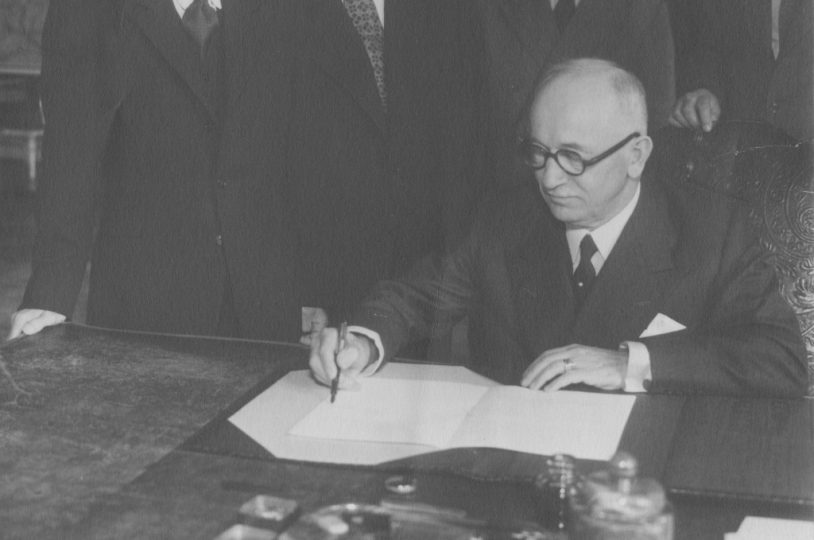
At the beginning of August, the decree was discussed and approved by the government and on 11th August submitted to the President of the Republic for signature. President Beneš’s signature was rather a symbolic matter as the President, according to his own words spoken in connection with the signature, supported this measure and considered it right.[24] In the Collection of Laws, the Decree of the President of the Republic No. 50/1945 Coll. On Measures in the Film Industry was officially promulgated on 28th August 1945. It gave the state exclusive authorisation to operate film studios, produce and process films, lend them, import, export and screen them publicly. This provision did not apply to amateur film and film activities within the Ministry of National Defence.[25]
One of the problems of the decree was that it turned out that in terms of the organisation of film industry, it was formulated solely as a provisional regulation and didn’t stipulate the form in which the state monopoly would be organised.[26] The decree stated that the organisation and administration of the state film business would be defined by a government regulation. It also stated that the Minister of Information ‘is authorised to take the necessary transitional measures to ensure its implementation until such time regulations are issued to implement this decree.’[27] All efforts to establish a monopoly film company were thus only provisional until the government decree on the establishment of the Czechoslovak State Film in April 1948.
For many reasons, the process of the nationalisation of the Czechoslovak film industry was very specific compared to other nationalised industries. For instance Elmar Klos, who actively participated in the process, explains the specificity as follows: ‘The socialisation of the film industry didn’t result from the will or intervention of the state, nor a propaganda campaign of a certain political party nor from an intervention by other public institutions. In Czechoslovakia, it happened because of a well-planned and prepared revolutionary act of filmmakers themselves, technical workers and labourers as well as a part of progressive managers and producers.’[28] Klos highlights the key role of the film workers themselves and it is necessary to say that their organisation in the National Committee of Czech Film Workers contributed to a quick and relatively smooth process of nationalisation of the industry. Within a few days after the liberation, they managed to win control over a majority of it.
The decree itself had a symbolic character in the eyes of the film workers and the representatives of the Ministry of Information as evidenced by many statements that appeared in the public space after it was signed by the President. It is also important to note how this document was treated from an ideological and cultural-political point of view by the Ministry of Information. For instance Minister Kopecký in his speech at a manifestation meeting of film workers at Barrandov on 14th August 1945 said that ‘
The nationalisation of the film industry is undoubtedly a significant success of the democratic power of the people, a victory of the revolutionary progress which now drives the development in our country and places Czechoslovakia among the leading progressive countries.’[29]
In addition to its symbolic character, the decree provided the representatives of the film industry an essential legal argument they could refer to in future disputes. But on the other hand, its provisional nature opened the door for potential criticism and relativisation. Perhaps the biggest opponent of nationalised film industry during the ‘Third Czechoslovak Republic’ was the Czechoslovak Sokol movement, which went from criticizing the expropriation of its former cinemas to proposing its own law on further measures in the field of film. Minister Kopecký and his Ministry described this effort as an attempt at denationalisation and published its own brochure in which they published and criticised the proposal.
According to Kopecký and other representatives of the film industry, implementation of this law would mean ‘a significant breach of one of the great revolutionary achievements of our people as is the nationalisation and unification of the entire film industry, or perhaps even a step back in a field so significant for our economic and cultural life such as film.’[30] This dispute over the drafted law submitted by the Czechoslovak Sokol in 1947 took place against the backdrop of rising tension between the Communist Party of Czechoslovakia and its opponents which culminated in February 1948.
However, in the years right after the war, the film industry was plagued by internal disputes stemming from a certain lack of thought in the decree and the absence of an implementing regulation which would define the organisation of the industry. This was manifested for example in the conflict between the director of the Czechoslovak Film Company Lubomír Linhart and the director of the Film Department of the Ministry of Information Vítězslav Nezval with regards to their respective authorities.[31] In 1947, the Ministry of Information decided that the appropriate way to implement the decree would be the creation of a state company. That happened in April 1948 after the Communist Coup d’état with the issuance of the Decree No. 72/1948 Coll. On the Establishment and Organisation of the State Company ‘Czechoslovak State Film’ which completed the centralisation and nationalisation of the Czechoslovak film industry.
The path to a state-controlled film monopoly can be described as a long-term process that cannot be limited only to the nationalisation decree from August 1945. The film industry was heading towards integration and centralisation already before the Second World War. In particular in the late 1930s, its support and closer relations with the state administration grew stronger which was due on the one hand to the need of the film administration to secure greater economic stability, but on the other hand also by the increased interest from the state in the cultural-political function of film. We also cannot ignore the fact that the Protectorate unification of the industry in the Bohemian-Moravian Film Union contributed to the relatively early post-war nationalisation. But the decisive factor of the entire process seems to be the personal continuity. Despite rapid political changes, many key positions within the industry remain occupied by the same people throughout the 1930s and the 1940s. However, the belief that after the war, a state film monopoly would be established, wasn’t limited to the representatives of film officials and workers, it was a widely spread idea in the society as well as politics.
Notes:
[1] Zdeněk Štábla, Data a fakta z dějin čs. kinematografie 1896–1945. Sv. 2. Prague: Československý filmový ústav 1989, p. 11.
[2] The Central Union of Cinemas associated the Provincial Union of Cinemas in Bohemia, the Provincial Union of Cinemas In Moravia-Silesia in Brno, the Union of Cinema-owners in Slovakia and the Sudeten German Union of German Cinemas in Czechoslovakia.
[3] Specifically, these were the Ministry of Industry, Trade and Commerce, the Ministry of Education and the Ministry of Foreign Affairs. Of the film institutions, the Union of Film Industry and Trade of Czechoslovakia, the Union of Film Production in Czechoslovakia and the Central Union of Cinemas in Czechoslovakia were represented in the Film Advisory Board. In 1937, representatives of the Ministry of National Defence, the Ministry of Finance, the Czechoslovak Film Society and the Czechoslovak Film Union were also included.
[4] Ivan Klimeš, Kinematografie a stát v českých zemích 1895–1945. Prague: Univerzita Karlova v Praze 2016, p. 179.
[5] Čs. filmová společnost se představuje, Filmový kurýr 10, 1936, p. 46, 13rd November, p. 1.
[6] Ivan Klimeš, op. cit., p. 266.
[7] National Film Archive, file Spolek Filmové Studio, index. 1, inv. No. 6. Notation from the Founding General Meeting from 3rd March 1937.
[8] International Film Chamber. Filmový kurýr 9, 1935, no. 19, 10th May, p. 1.
[9] Tereza Czesany Dvořáková, The idea of a Film Chamber. The Bohemian-Moravian Film Union and continuity of centralizing tendencies in the film industry in the 1930s and 1940, Prague 2011. Disertation. Department of Film Studies, Faculty of Arts of the Charles University, pp. 27–28.
[10] In July 1939 the Film Industry Central, on the orders of Film Commissioner Herman Glessgen appointed by the Office of the Reich’s Protector, appointed plenipotentiaries for individual segments of the film industry. These later served as a basis for the Bohemian-Moravian Film Union as an umbrella organisation for all subjects from the film industry. In November 1939, the Film Central transformed into the Committee of Plenipotentiaries. In the spring of 1941, film organisations used the platform of the Film Studio which they transformed again into the Bohemian-Moravian Film Union.
[11] Tereza Czesany Dvořáková, op. cit., p. 155.
[12] Cf. Ivan Klimeš, op. cit., p. 251.
[13] Jak byl znárodněn československý film. Svědectví a dokumenty (III). [Interview with Emil Sirotek]. Film a doba 11, 1965, no. 4, p. 182.
[14] Jak byl znárodněn československý film. Patnáct let filmové politiky. [Jindřich Elbl]. Film a doba 11, 1965, no. 8, pp. 396–397.
[15] National Revolutionary Intelligence Committee was an illegal anti-Nazi resistance group of cultural workers created in 1941 on the initiative of the Second Illegal Central Leadership of the Communist Party of Czechoslovakia.
[16] Jiří Havelka, Československé filmové hospodářství 1945–1946, Prague: Čs. filmové nakladatelství 1947, pp. 15–16.
[17] Jan Kuklík, Znárodněné Československo: od znárodnění k privatizaci – státní zásahy do vlastnických a dalších majetkových práv v Československu a jinde v Evropě. Prague: Auditorium 2010, p. 171.
[18] This programme is designated as the Košice Government Programme as it was declared on 5th April 1945 in liberated Košice, Slovakia.
[19] Jana Pávová, Demagog ve službách strany: portrét komunistického politika a ideologa Václava Kopeckého. Prague: Ústav pro studium totalitních režimů 2008, p. 59.
[20] Jindřich Elbl. Šest let otroctví skončilo, Filmová práce 1, 1945, no. 1, 26th May, p. 3.
[21] Čistka ve filmovém oboru. Filmová práce 1, 1945, no. 3, 9th June, p. 2.
[22] Jmenování prozatímních zmocněnců ve filmovém oboru, Filmová práce 1, 1945, no. 1, p. 2.
[23] Marek Danko, Film in the hands of the state is in the hands of the people“ Nationalization of Cinemography in Third Republic Czechoslovakia. Prague 2021. Diploma Theses. Faculty of Arts, Institute of Czech History, pp. 50–51.
[24] Československý film v rukou státu. Filmová práce 1, 1945, no. 13, 18th August, p. 2.
[25] Karel Jech a Karel Kaplan (eds.), Dekrety prezidenta republiky 1940–1945: dokumenty. 2., Brno: Doplněk 2002, p. 386.
[26] Ivan David, The Birth of a Law from the Spirit of the Era: The Long Legislative Journey to the Statutory Order No. 72/1948 Coll. On Foundation and Organisation of the Czechoslovak State Film State Enterprise. Prague 2013. Bachelor Thesis. Charles University, Faculty of Arts, Department of Film Studies, p. 69.
[27] Karel Jech a Karel Kaplan (eds), op. cit., p. 387.
[28] Elmar Klos. S odstupem času, Iluminace 3, 1991, no. 2, p. 106.
[29] Vítězslav Nezval. Zestátněný film zárukou svobodné kulturní tvorby. Filmová práce 1, no. 13, 18th August, p. 1.
[30] Znárodněný film a pokusy o jeho odnárodnění: (k návrhu zákona, kterým se sahá na samu podstatu dekretu presidenta republiky o znárodnění filmu). Prague: Československé filmové nakladatelství 1947, p. 30.
[31] Petr Szczepanik, Továrna Barrandov: svět filmařů a politická moc 1945–1970. Prague: National Film Archive 2016, pp. 67–69.