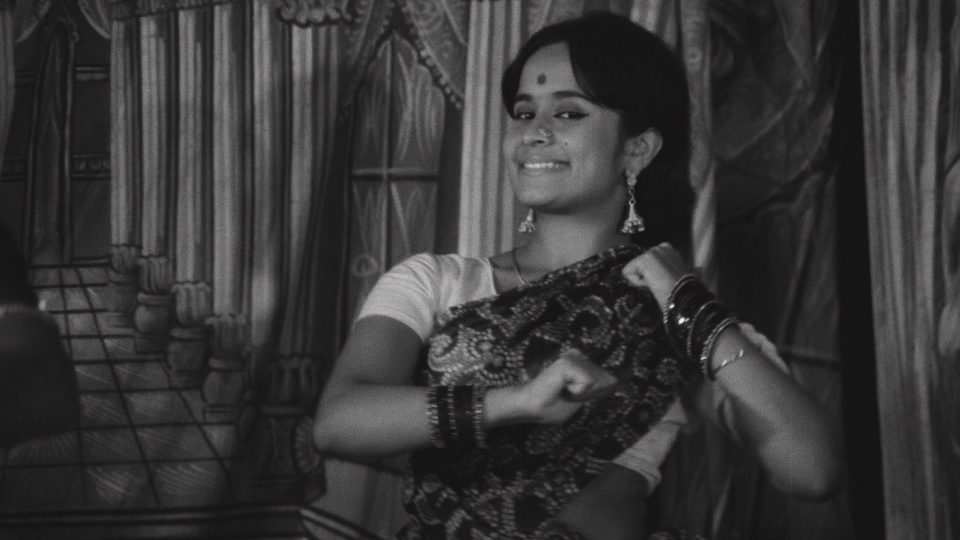
On November 6, the Ponrepo Cinema screened two Indian feature films, Devdas (1955) and Badnam Basti (1971), with the participation of Stefanie Schulte Strathaus and Markus Ruff from the Berlin-based Arsenal Institute for Film and Video Art. The curatorial selection of Devdas from the collection of Národní filmový archiv, accompanying Arsenal’s digitally restored Badnam Basti, was in charge of Indian director and FAMU International graduate Apoorva Satish.
Prem Kapoor’s Badnam Basti has long existed as a rumour in Indian film history, a title occasionally mentioned, rarely seen, and almost never discussed. Completed in 1971 and based on Kamleshwar’s novella of the same name, it stands today as the earliest known Indian feature to centre openly on same-sex desire. Built around a bisexual love triangle, it challenged the moral codes of its time. For decades, it was believed to be lost, surviving only as a citation in festival catalogues. Its recent restoration has finally made it possible to reassess this singular and boundary-breaking film.
Set in the arid landscape of small-town Uttar Pradesh, the film follows Sarnam, a former outlaw trying to rebuild a modest life as a truck driver. His world changes when he encounters Bansuri, a young woman he cannot fully claim, and Shivraj, a man who unsettles his sense of self. The bond between Sarnam and Shivraj is depicted with startling tenderness. In this sense, Badnam Basti presents queerness not as identity but as a way of seeing; one that questions and challenges fixed ideas of gender and morality. Rather than create conflict between the three central characters, Kapoor quietly observes how their loyalties and vulnerabilities overlap. The emotions are allowed to remain undefined, which is unusual for a period when Hindi cinema relied on clear moral positions and explicit romantic resolution.
Formally, the film’s avant-garde structure intensifies its subversive potential. Kapoor’s use of fragmented editing, overlapping sound, and non-linear storytelling evokes the disorientation of desire itself. The unpredictability of the film’s rhythm mirrors the unpredictability of the emotional terrain; scenes begin and end abruptly, never letting the audience settle into the narrative. This is especially striking considering the era’s mainstream cinematic grammar, which relied on smooth continuity and strong cues about how viewers should feel. Badnam Basti is shot partly in documentary style yet punctuated by stylised sequences and surreal juxtapositions. Characters speak, then lapse into silence; songs interrupt scenes, functioning as emotional confession. These creative choices align Badnam Basti with contemporaneous global art cinema, from Godard’s formal experimentation to the raw emotional depth of Ritwik Ghatak, while Kapoor’s approach remains distinctly rooted in Hindi literary modernism.
The film’s title, literally “The Disreputable Neighbourhood”, reflects its focus on characters pushed to the edges of society. The basti becomes a metaphor for social marginality: a place for those dismissed or looked down upon by society. Yet Kapoor’s gaze is empathetic, not voyeuristic. His camera lingers on faces and spaces usually erased from representation, rendering them sites of quiet dignity. For a Hindi film of 1971, this approach was virtually unprecedented. What is interesting about the film is how instead of portraying marginal figures as threats or objects of pity, the film recognises them as individuals with emotional complexity and agency. This is perhaps why the queerness depicted in the film is so seamless. Desire is shown as part of ordinary life for people who are already outside structures of respectability.
Devdas unfolds within the socially privileged world of a landed Bengali household, where love is shaped less by personal feeling than by status, propriety and obligation. Devdas’s lifelong connection to Paro is sincere but constantly mediated by social expectation, and his return from Calcutta only sharpens that divide. Chandramukhi enters not as a rival but as another emotional possibility that Devdas cannot allow himself to accept. The relationships remain tense not because of conflict between the women, but because Devdas is unable to reconcile his desire with the rules he has internalised. Bimal Roy observes the three central figures with the clarity of moral tragedy: every choice Devdas avoids becomes another step towards self-destruction. The emotions are never left vague or unspoken, reflecting a moment in Hindi cinema when love on screen was expected to declare itself explicitly and to end in sacrifice if it crossed the boundaries of social order.
By contrast, Devdas uses a classical and carefully composed visual language. Its emotional world is built through symmetry, balance and controlled framing rather than experimentation. Shots unfold in measured, uninterrupted takes, allowing the actors’ performances and dialogue to carry the weight of feeling. Lighting emphasises softness and stillness, giving emotional scenes a polished, almost ceremonial quality. Interiors are structured to highlight distance characters framed across doorways, thresholds and partitions making separation literal in the mise-en-scène. Music and songs are used as a reinforcement of mood, guiding the viewer towards a clear emotional reading. Every visual element is designed to create coherence and inevitability, reflecting a world where love and duty cannot coexist without consequence.
Devdas has long stood as the template for Indian romantic tragedy, a story where love becomes inseparable from guilt, duty, and self-destruction. Adapted many times across languages, it shaped how generations understood sacrifice and moral purity in love. Devdas’s downfall is not just personal but ideological: his inability to cross the boundaries of class and custom turns desire into suffering and reinforces the very social order that denies him happiness. The film’s heightened melodrama and emotional excess transform heartbreak into a spectacle, offering catharsis while preserving moral stability. In doing so, Devdas became the ultimate portrait of doomed, socially sanctioned love in Indian cinema. Despite its critique of social norms, Devdas ultimately upholds them by presenting the cost of transgression as inevitable ruin.
When placed side by side, Devdas and Badnam Basti chart two very different emotional landscapes within Indian cinema. In Devdas, emotion takes centre stage through its grand gestures and lyrical sorrow, with the hero’s downfall becoming a moral parable. Badnam Basti, made only sixteen years later, dismantles that logic. It turns the camera towards people who live outside social privilege and romantic idealism. Sarnam’s attachment to both Shivraj and Bansuri is not judged or glorified; it simply exists in the messiness of daily life. Where Devdas builds emotional tension through spectacle, Badnam Basti builds it through understatement and everyday detail. This contrast reveals how Kapoor’s film resists the idea that love must declare itself to be real. It is a portrait of desire that does not ask for recognition, and does not fall apart without it.
What makes Badnam Basti so striking today is not only its queerness but its refusal to dramatise it. Kapoor strips emotion of spectacle, finding intimacy in small gestures and incomplete thoughts. His fractured narrative anticipates the realism of later Indian independent cinema, while his openness towards desire points forward to queer storytelling that would take decades to surface openly. In contrast to Devdas, Badnam Basti presents desire as endurance and resistance to conformity. The film’s tragedy is not death or loss but the absence of recognition, the silence surrounding lives and desires that continue without visibility. The difference is crucial: Devdas punishes transgression, whereas Badnam Basti simply lives with it.
Seen today, Badnam Basti does not feel like a film from the past. Its language, its honesty, and its restraint still feel fresh. It reminds us that Indian cinema once had the courage to look at love without labels, to show people as they are, and to leave space for what cannot be said. That is what makes it matter now: not only as a historical first, but as a film that still speaks, quietly but directly, to the present.
Badnam Basti’s restoration is a stark reminder that the emotional language of Indian cinema might have evolved differently had it stayed alive in the culture alongside Devdas, instead of being lost before it could contribute to shaping how love was shown and understood.