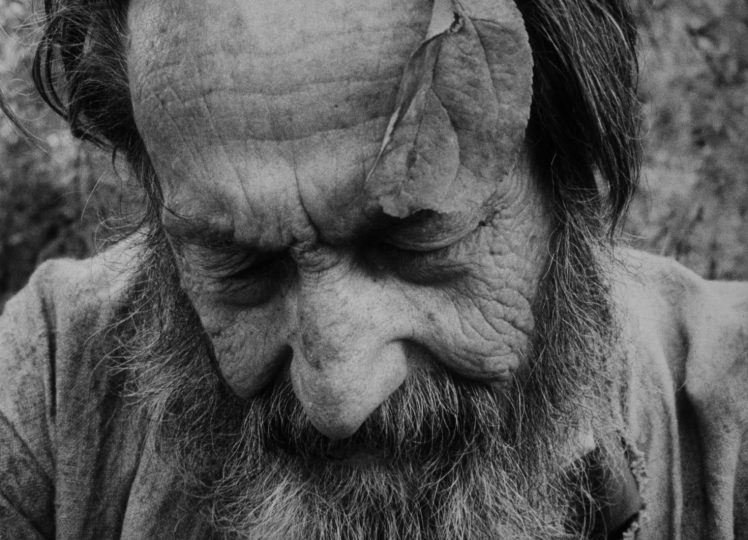
Ivan Balaďa (1936–2014) was the author of a single feature film. And even that one, shot at the end of the 1960s, waited twenty years to be completed. Based on Chekhov’s short story Ward No. 6, The Ark of Fools (Archa bláznů), a stylized allegory about the disintegration of the self under external pressure, is set in the microcosm of a neglected psychiatric hospital. With almost painful sharpness, the film captures the atmosphere of disillusionment and stagnation after the Warsaw Pact invasion of Czechoslovakia in which even the most morally steadfast individual is ultimately unable to resist the surrounding dullness and indifference.
Before The Ark of Fools, Balaďa directed many TV films and stage productions, and thanks to that he gained extensive experience with the classics of Russian literature. When he was given the opportunity to make his first feature film at the Barrandov Film Studios, he chose Chekhov’s story about Andrei Ragin, the chief physician of a provincial hospital who is surrounded by pettiness, incompetence, and madness – and who, unable to prevent the world’s decay, gradually loses faith in both humanity and reason. For a man of conscience in a deranged era, there is no other path.
The screenplay was adapted by Lubor Dohnal who remained faithful to the story’s bleakness, naturalism and Russian provincial setting, yet emphasized its timelessness and symbolism. The film adaptation took on an almost apocalyptic character. The Juráček-Kučera creative group approved Dohnal’s script on June 17, 1969, and the production was authorized the following day. The filming began on September 11, 1969, but due to constant reshoots and uncertainty about how each shot would play out, the progress was slower than planned.
At the end of November, when several important scenes still remained to be shot, the production was halted. According to the official documentation, it was because of unexpected snowfall; according to Dohnal’s recollections, however, it was because Balaďa was still dissatisfied with the pair of latex corpses that he needed for the opening scene (and that, in the end, never appeared in the film). Whatever the reason for the break, the filmmakers used it to edit the material they had already shot.
The filming was originally supposed to take place in a real hospital, but during location scouting the crew came across a dilapidated chateau Zahrádka in the village of Petrovice near Příbram and a similarly decaying brewery nearby. The film’s rawness is further emphasized by the casting. Apart from the main characters (for instance the one played by Zlatomír Vacek), the cast consisted largely of non-professionals, including singer-songwriter Vladimír Merta and journalist Čestmír Klos. Other non-actors were brought to the set from Prague pubs and retirement homes, and part of the extras were people with actual physical disabilities.
The film’s expressive power was heightened by the costumes and visual design of Ester Krumbachová, as well as by Juraj Šajmovič’s high-contrast black-and-white cinematography, for which he chose to shoot entirely with a handheld camera. This decision, however, led to a significant increase in the amount of film stock used due to the unpredictability of movement in front of the lens. Moreover, Balaďa demanded multiple versions of individual scenes, which meant that when he finally sat down in the editing room at the end of 1969, he was faced with a chaotic tangle of images that he and editor Alois Fišárek (for whom this was the first film!) struggled long and arduously to bring into any kind of order.
In the meantime, though, Barrandov’s management had changed, and the new leadership was not at all sympathetic to the film’s depressive, experimental allegory. When Balaďa and Fišárek emerged from the Czechoslovak Army Film editing room in March 1970, after four months of intensive work, the rough cut was shown to the studio director and the chief dramaturge. At first, they surprisingly granted permission for the work to continue through to the sound mix. But at the very next management meeting, the decision was reversed: only the most necessary reshoots were to be completed, and a film print would be made with dialogue tracks only. On June 15, 1970, the production was officially halted.
No one communicated with the filmmakers, they were left in uncertainty about what the problem actually was. Gradually, however, they learned that their film was allegedly too pessimistic and, moreover, anti-Soviet, as it distorted both Chekhov’s legacy and the portrayal of life in Russia. The negative, stored not in a vault but in the film laboratories, was to serve as an exemplary case of a work that promoted ideological subversion among Czechoslovak viewers. Domestic filmmakers were henceforth to avoid producing such works.
The Ark of Fools was not completed until 1990, when post-synchronization was finished and Štěpán Koníček’s original score was finally added. The narrator’s commentary, read by Pavel Landovský, was also written at that time. The film, a mosaic-like account of the destruction of all hope, premiered in July 1990 in the Liberated Films (Filmy osvobozené) section of the Karlovy Vary International Film Festival. It entered distribution in November 1990, attracting minimal audience interest; in the post-revolutionary atmosphere, viewers, much like the state film authorities twenty years earlier, were likely unwilling to confront such a bleak vision of a society in which madness is the only possible response.
The Ark of Fools (Czechoslovakia 1970/1990), director: Ivan Balaďa, script: Lubor Dohnal, cinematography: Juraj Šajmovič, music by: Štěpán Koníček, cast: Zlatomír Vacek, Antonín Horák, Vladimír Merta, Elena Zvaríková-Pappová, Zora Rozsypalová, Eva Řepíková, Vlastimila Vlková, Zuzana Fišárková, Hana Slivková, and others. Barrandov Film Studio, 105 min.
Bibliography:
Štěpán Hulík, Kinematografie zapomnění počátky normalizace ve Filmovém studiu Barrandov (1968 1973). Praha: Academia 2011.
Edith Jeřábková, Kateřina Svatoňová (eds.), Ester Krumbachová. Praha: VŠUP, UMPRUM 2022.
Lukáš Skupa. Vadí – nevadí česká filmová cenzura v 60. letech. Praha: NFA 2016.