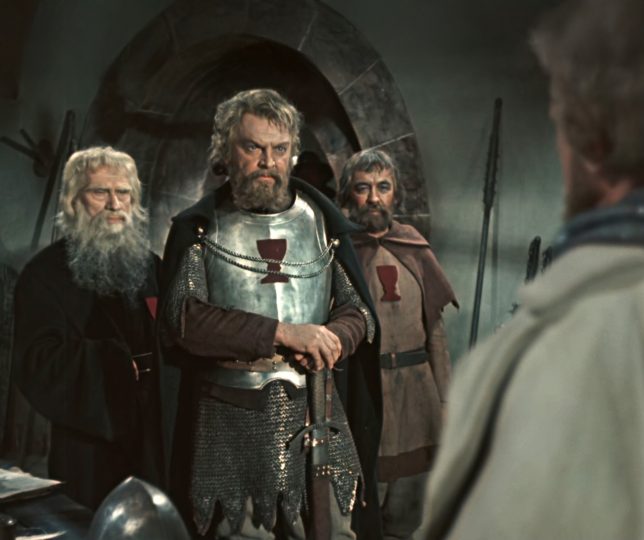
“Today, when we are, after the Second World War, building a people’s republic, the establishment of which is based on the ideas of the Slovak National Uprising and the Prague Uprising, on the ideas of the brotherhood of Slavic peoples, when we are completing the efforts of Žižka’s field troops to expel foreigners from our homeland and to make people of all professions equal, Jan Roháč of Dubá comes as convincing proof that the path pursued by the Hussites was the right one.”[1]
This was the poetic introduction of a contemporary review of the first Czechoslovakian feature-length colour film. Jan Roháč of Dubá (1947) was a long-awaited project meant to showcase the advancement of the nationalised cinema, and at the same time boost the self-confidence of the nation with its message. In line with the post-war mood of society, the Hussite warlord after whom the film is named in Czech is portrayed as a symbol of national resistance against the German oppressor. From the perspective of the film based on Alois Jirásek’s drama, Hussitism was not only a religious movement but also a social one, and as such it contributed to social upheaval and national liberation.
Jirásek’s works had attracted domestic filmmakers since the First Czechoslovak Republic. An adaptation of the fairy-tale play The Lantern (Lucerna, 1925) was made by Karel Lamač already during the writer’s lifetime. Six years later, Svatopluk Innemann adapted Dog’s Heads (Psohlavci, 1930) based on Václav Wasserman’s script; the novel was later made into a film also by Martin Frič (1954) and Milan Macků (1985). There were three versions of Vojnarka (Vojnarka) as well, with the first one directed by Vladimír Borský in 1936. To make the list of the pre-war adaptations complete, there was also Vávra’s A Philosophical Story (Filosofská historie, 1937) and one more take on The Lantern, once again by Karel Lamač.
In 1946, shortly after post-war nationalisation, Karel Feix, the head of one of the Barrandov Studio production groups, asked Vladimír Borský to meet him. During their conversations, they came up with the idea to make the first Czechoslovakian colour film based on Jirásek’s drama Jan Roháč of Dubá. The subject was chosen so that the technical possibilities of colour film could be used to the maximum extent. The choice of Borský as director was also a practical one; he had assisted the German director Willi Forst on the colour film Young Girls of Vienna (Wiener Mädeln, 1945) during the war. One of the cinematographers of this colour musical, Jan Stallich, was also approached for the Jan Roháč project. He invited Václav Huňka and Alois Jiráček to work with him.
Architect Jan Zázvorka, who took care of the set design and artwork in the film, also had previous experience with colour filming. Shortly after the war, he worked on the colour film The Stone Flower (Kamennyy tsvetok, 1946), which was shot at Barrandov by Soviet filmmakers.
The actual filming of Jan Roháč of Dubá only started after careful preparations. Borský, who also co-wrote the script, had studied both the play and the extant written and visual material related to the Hussite wars. Period costumes needed to be made for the actors and several hundred extras; extensive sets had to be built. The Emperor’s Chamber, the Coronation Cathedral, the Councillor Hall of the Old Town Hall, and Sion Castle were created in the Barrandov and Radlice studios.
The production of the epic historical blockbuster began on May 20, and from the start, the film magazines covered it almost day by day, preparing readers for a spectacular experience. Informační zprávy published short reports focusing, for example, on the costumes, the cast, the set constructions, or the special responsibilities of the make-up artists and lighting technicians during the Agfacolor filming.
“Until now, only painters have been able to think in colours and use colours. Now they are joined by the filmmakers, who must learn to compose: they must be able to merge image and sound, the two basic elements of a black and white film image, with the third element – colour – into a harmonious unity”, Vladimír Borský said, explaining the specifics of colour filming.[2]
Other periodicals of the time also spent months preparing the public for a historically faithful big screen film with great battle scenes. “So, I watched how battles are shot. Director Borský has a firm grip on the set, commanding the fights in compliance with all the rules of the art of film direction, and it is not his fault if this or that situation gets a little out of hand,” wrote Milan Noháč about his exciting visit to the set.[3]
Following the remnants of the Hussite army during the last phase of their fight against King Sigismund, the film premièred in the three largest Prague cinemas at the end of March 1947. The screening at the Sevastopol cinema on Friday, March 28, was attended by President Edvard Beneš and Prime Minister Klement Gottwald. The opening speech was made by Vítězslav Nezval, chairman of the film department of the Ministry of Information (later Ministry of Culture). Despite the high expectations, though, the reception was rather lukewarm, as evidenced by review headlines such as “Failed Official Epic Film”.
The script was said to be too descriptive, lacking action, drama, and gradation. The critics stated that the dialogues only commented on what the viewers could see, doing nothing to elucidate the psychology of the protagonists. A. M. Brousil described the first great event of post-war Czechoslovak film as “a drawn-out series of historical events.”[4] The film was considered representative mainly from the technical point of view. Most reviewers agreed that Jan Stallich’s camera was of top quality: “Nobody has ever seen such delicious shades of green,” Vlado Bahna gushed in the magazine Kino.[5]
Despite the largely negative domestic reactions, the leaders of Czech film did not give up hope that it would appeal to foreign audiences, as intended from the very beginning. Jan Roháč of Dubá was chosen to represent nationalised cinema at the Brussels Film and Art Festival in June 1947. The colourful historical epic was also shown at the Czechoslovak Film Festival in London and sold to Norway and the Netherlands. The international success did not come, though; Oldřich Kautský commented on this in Kino:
“If the film was to do its service and fulfil its ideological mission in its homeland, then it was filmed by right. But why force foreigners to watch a work that is incomprehensible to them, that has no international validity, and blame its failure on their lack of understanding and on subtitles made with frugality in mind?”[6]
Although Jan Roháč of Dubá did not live up to the artistic expectations, it foreshadowed what historical subjects would dominate domestic film screens in the years to come. As early as November 1948, the so-called “Jirásek Action” was announced, the aim of which was to highlight the works of Alois Jirásek, who was then essentially perceived as the official historian of the Communist Party. His novels about the Hussites were particularly popular, fitting in with the Party’s efforts to revive revolutionary, progressive traditions and to create the illusion that the Party was building on the legacy of such giants of Czech history as Jan Žižka and Jan Hus. While the Hussite tradition “revival” was still relatively spontaneous right after the war, later it was only a matter of meeting the directives or rather the “thematic plan.”
In Otakar Vávra’s infamous trilogy, the Hussites already stood on the side of the working people and embodied all goodness and progress in accordance with the Marxist perspective. While from the romantic and adventurous point of view the films offered an escape from political propaganda, from the ideological point of view they were propaganda by design. Following the Soviet model, they were to consolidate the national consciousness and rewrite the Czech history as if it were a permanent struggle of the oppressed working class against the powerful, represented by the Catholic Church and the nobility.
The period about which Jirásek wrote served best for such a utilitarian use of history, for according to the interpretation of Nejedlý, the Minister of Education, the communist victory was a logical outcome of the historical development started by Hussitism.
Jan Roháč of Dubá (Czechoslovakia, 1947), director: Vladimír Borský, script: Vladimír Borský, Otakar Růžička, Sonja Špálová, cinematography: Jan Stallich, music: Otakar Jeremiáš, cast: Otomar Korbelář, Ladislav Boháč, Emil Bolek, Felix le Breux, Otto Čermák, Rudolf Deyl ml., Gustav Ekl, Lili Hodačová, Ladislav Kulhánek, and others. Československá filmová společnost, 102 min.
Notes:
[1] -rp-, Jan Roháč z Dubé. Filmové noviny 1, 1947, no. 14 (05/04), p. 5.
[2] Režisér Vl. Borský o barevném filmu. Informační zprávy 1, 1946, no. 16 (01/07), p. 5.
[3] Milan Noháč, Jan Roháč z Dubé očima reportéra. Kino 1, 1946, no. 15 (28/06), p. 242.
[4] A. M. Brousil, První československý barevný film. Zemědělské noviny 3, 1947, no. 3 (30/03), p. 2.
[5] Vlado Baran, Jan Roháč z Dubé. Kino 2, 1947, no. 17 (25/04), p. 324.[6] Oldřich Kautský, Přemýšlejte s námi o kritice a důkazech pravdy. Kino 2, 1947, no. 43 (24/10), p. 843.