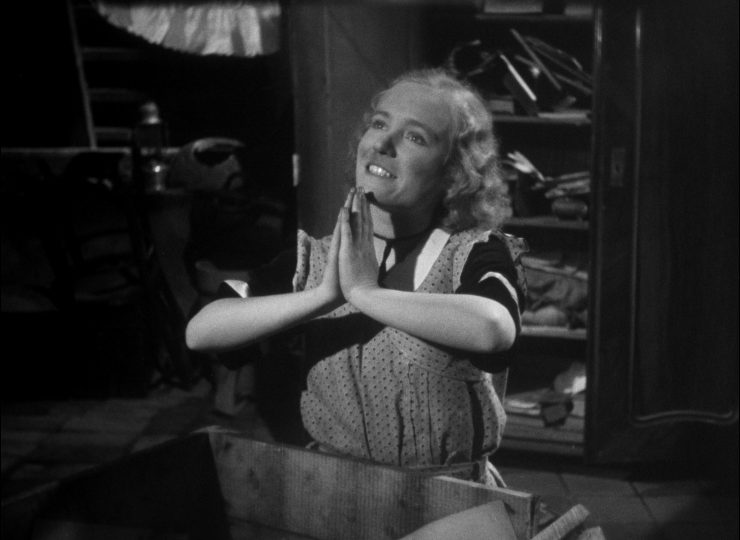
The work of E. F. Burian belongs among the most distinctive expressions of the Czech cultural avant-garde of the interwar period. His only prewar film, Věra Lukášová (1939), based on a novella by Božena Benešová and on Burian’s own stage play, represents an exceptional attempt to transpose theatrical poetics onto the cinema screen. It was made in the oppressive political climate following March 1939 and was soon banned. The work deliberately went against the prevailing film trends of the time, defined by light-hearted comedies and melodramas, and precisely for that reason was ahead of its time. To this day, it remains an inspiring example of the intermedial blending of film, theatre, and music.
E. F. Burian (1904–1959) can without exaggeration be described as a Renaissance artist – he was a theatre practitioner, playwright, composer, poet, actor, director, and political activist. His work was consistently marked by ideological commitment and formal inventiveness that refused compromise. From the 1920s onward, he was connected with the Poetist and leftist avant-garde centred around the Devětsil group. Beginning with the founding of his own stage, D 34, in May 1933, he began to promote a synthetic theatre in which music, image, word, light, and set design merged into a unified statement.
Burian’s theatre was founded on the idea that art should serve as a tool for social transformation. Innovative stage techniques turned his productions into multimedia events. By combining stage action with film projection (a method he called Theatergraph), he anticipated Laterna Magika – a project later created by one of his students from the D 34 theatre, Alfréd Radok – by twenty years. “E. F. Burian was a master of style, of stylistic unity. In his productions everything complemented one another and moved toward a single goal,” Radok later characterized Burian’s approach.[1]
In the 1930s, Burian also began working to elevate the artistic level of Czech cinema. He perceived film as he did jazz – as an expression of the modern age. For this reason, he welcomed Vladislav Vančura’s invitation to collaborate on his directorial debut Before Graduation (Před maturitou, 1932). Burian composed several songs for the film and sang them himself. He sang again in the popular romantic drama The Golden Bird (Zlaté ptáče 1932), this time appearing on screen as a bar singer. For the third time he sang in the role of a woodcutter in From the World of Forest Solitude (Ze světa lesních samot, 1933), although no longer performing his own songs.
Burian’s sense of rhythm also manifested in Věra Lukášová, his first and only prewar film as a solo director. He first approached the material as a theatre artist. The psychological short story Don Pablo, Don Pedro a Věra Lukášová (Don Pablo, Don Pedro and Věra Lukášová 1936) by Božena Benešová served as the basis for a production at his D 39 theatre, premiered on November 29, 1938.
The protagonist of the story is a daydreaming twelve-year-old girl, Věra, who in the course of her adolescence retreats to imagined heroes and places, only to come up against the hypocritical morality of adults. These are represented by her grandmother, with whom she lives after the death of her parents, and the lecherous Mr. Láb. The production attracted considerable attention not only for its formal qualities but also for its ideological emphasis. The heroine’s struggle against authority was perceived by contemporary audiences as a symbol of the Czech nation’s defiance. Shortly after the Nazi occupation, however, the play was banned.
Aware of both the power of the material and its contemporary significance, Burian decided at the beginning of 1939 to bring it to the cinema screen. The film too was soon banned by the Protectorate government on the grounds that it promoted Judaism and sympathized with democratic, that is anti-fascist, forces in Spain (Věra is shown reading a pulp novel about Spanish noblemen fighting against evil). Burian considered the ban absurd and appealed to Jaromír Nečas, the Minister of the Protectorate government. His efforts, however, were in vain. Instead, he was arrested in April 1941 and deported to the Dachau concentration camp, and later to Neuengamme near Hamburg.
The screenplay, which Burian co-wrote with Vladimír Přikryl (known after the war as Vladimír Čech), took the form, according to Luboš Bartošek, of a score that captured with great precision both the visual and the acoustic components of the film. It thus served not only as a basis for his direction and for the work of cinematographer Jan Roth, but also for the subsequent composition of the film’s score written by Burian himself. The result was not a traditional, linearly developed dramaturgical structure. Already at the literary stage, the determining factor was the rhythm of the music, which, as Jan Šmolík’s dissertation argues, “served as a unifying element that brought all the scenes to a common denominator, as a narrative device in its own right, and as a means of psychologically shaping the characters and setting.”[2]
The musical accompaniment is provided by a string quartet, namely by the chamber ensemble Pešek Quartet, with each voice representing a different character, which allowed for a sophisticated dramatization. The first and second violins correspond to Věra and Jarka, the viola to Grandmother Lukášová, and the dark-toned cello to the predatory Láb. The contrast between the younger and older pair of characters is expressed through the use of identical musical motifs for each pair. The basic musical motif recurs just like the central theme of the story – Věra’s effort to discern truth from falsehood, good from evil. For the film’s music, Burian was awarded the Provincial Prize for 1939.
Sound effects also play a significant role in creating the film’s atmosphere – for example, the unceasing song of birds in the scene where Věra gathers flowers in a meadow. The sound dimension does not merely underscore the visual one. It becomes dominant, characterizing the characters and the setting, anticipating the action. The lyrical exterior shots are often subordinated to it. In contrast to contemporary domestic practice, Burian regarded sound as equal to the other expressive means of the film medium.
Music that responds to changes in emotions and situations simultaneously helps viewers navigate the stylized film space. Cinematographer Jan Roth imparted a distinctive visual style to the film that corresponds to Burian’s poetics. The filming took place mainly on location in the town of Vlašim – sunlit meadows, a pond, and parks contrast with the gloomy interiors. On the boundary between these spaces lies a dark transitional alley where it is openly acknowledged that studio sets were used. This contrast also reflects the inner worlds of the characters. Věra’s is sunny, open, and free, whereas the world dominated by her grandmother and the eccentric Mr. Láb is dark, closed, and oppressive.
In addition to poetic imagery, the theatrical stylization is evident in the poetic dialogues and the mannered performances of Jiřina Stránská, Rudolf Hrušínský, and others, mostly stage actors. Burian outlined his approach to directing actors in a contemporary article for Pražský ilustrovaný zpravodaj (Prague Illustrated Gazette). From his words, his effort to differentiate himself from conventional filmmaking is clear: “The people in the film studio were amazed that it was possible to make a film without shouting, clamour, and fake haste – elements that, until then, film directors (not only ours) considered indispensable to their sense of importance.”[3]
Contemporary critics, however, were divided. The film was described as unclear, confused, torn apart, and yet magnificent. At times, the critics felt it appeared almost amateurish, with shots alternating in disorder, while at other moments it dazzled with directorial virtuosity. According to a review signed by Bedřich Rádl and Jaroslav Režný, Burian created “a film which, after long and tedious passages with many gross violations of the most basic principles of film construction, reveals places of rarely seen beauty and perfection.”[4]
Through its non-cinematic qualities, absence of traditional narrative, and focus on lyrical moments, it also confused audiences accustomed to the more conventional forms and genres of Czech films. From today’s perspective, however, Věra Lukášová can be understood as an extraordinary contribution to the history of intermedial art – a stylized audiovisual work that, through innovative use of established expressive means, does not literally depict reality but figuratively conveys the mental states of an adolescent girl coming to terms with her moral stance toward the world.
The dreamily lyrical film is thus not merely an adaptation of a literary or, by extension, a theatrical source, but also a manifesto of Burian’s belief that formal experimentation is necessary, that art should have an ethical dimension, and that, in difficult times, even film can serve as a tool of resistance. It is a work the aesthetics of which foreshadows the development of modern cinema and simultaneously attests to E. F. Burian’s extraordinary contribution to Czech cinematography.
Věra Lukášová (Czechoslovakia 1939), director: E. F. Burian, script: E. F. Burian, Vladimír Čech, cinematography: Jan Roth, music: E. F. Burian, cast: Jiřina Stránská, Rudolf Hrušínský, Lola Skrbková, Zdeněk Podlipný, Jarmila Bechyňová, Pavla Machníková, Zdeňka Podlipná. Elekta, 92 min.
Bibliography:
Luboš Bartošek, Dějiny československé kinematografie, zvukový film 1930-1945, část 2. Praha: Státní pedagogické nakladatelství 1983.
Jaroslav Kladiva, E. F. Burian. Praha: Jazzová sekce SH 1982.
Antonín Matzner, Jiří Pilka, Česká filmová hudba. Praha: Dauphin 2002.
Mladá česká Markétka a zcela starý Faust. Pražský illustrovaný zpravodaj, 1939, no. 32 (10/08), p. 23.
Bedřich Rádl, Jaroslav Režný, Jak se dívati na Věru Lukášovou. Kinorevue 6, 1939, no. 8 (11/10), p. 144.
Alfréd Radok, Kolumbovo vejce Laterny Magiky. Národní divadlo. Available online at: <https://www.narodni-divadlo.cz/cs/emagazin/kolumbovo-vejce-laterny-magiky-alfred-radok-140845752> [cited 03/06/2025].
Zprávy z naší produkce, Kinorevue 6, 1940, no. 22 (17/01), p. 435.
Notes:
[1] Alfréd Radok, Kolumbovo vejce Laterny Magiky. Národní divadlo. Available online at: <https://www.narodni-divadlo.cz/cs/emagazin/kolumbovo-vejce-laterny-magiky-alfred-radok-140845752> [cited 03/06/2025].
[2] Cited in Antonín Matzner, Jiří Pilka, Česká filmová hudba. Praha: Dauphin 2002, p 142.
[3] Mladá česká Markétka a zcela starý Faust. Pražský illustrovaný zpravodaj, 1939, no. 32 (10/08), p. 23.
[4] Bedřich Rádl, Jaroslav Režný, Jak se dívati na Věru Lukášovou. Kinorevue 6, 1939, no. 8 (11/10/), p. 144.